परिभाषा: विद्युत आवेशित परमाणु या परमाणुओं के समूह को आयन कहते हैं।
निर्माण: जब कोई परमाणु इलेक्ट्रॉन खोता (Loss) है या पाता (Gain) है, तब आयन बनता है।
प्रकार: मुख्य रूप से दो प्रकार के होते हैं— धनायन (Cation) और ऋणायन (Anion)।
धनायन (Cation): इलेक्ट्रॉन के त्याग (Loss) से बनता है।
इस पर धनात्मक (+) आवेश होता है।
प्रोटॉन की संख्या > इलेक्ट्रॉन की संख्या।
उदाहरण: Na+, Ca2+, NH4+(अमोनियम)।
ऋणायन (Anion): इलेक्ट्रॉन ग्रहण (Gain) करने से बनता है।
इस पर ऋणात्मक (-) आवेश होता है।
इलेक्ट्रॉन की संख्या > प्रोटॉन की संख्या।
उदाहरण: Cl−, O2−, SO42− (सल्फेट)।
बहुपरमाणुक आयन (Polyatomic Ions): परमाणुओं का वह समूह जो एक इकाई की तरह कार्य करता है और उस पर निश्चित आवेश होता है (जैसे: OH−, NO3−)।
आयनिक बंधन (Ionic Bond): धनायन और ऋणायन के बीच स्थिर वैद्युत आकर्षण बल (Electrostatic Force) के कारण बनने वाला बंध।
संयोजकता (Valency): किसी आयन पर मौजूद आवेश की संख्या ही उसकी संयोजकता कहलाती है।
कैथोड और एनोड: विद्युत अपघटन (Electrolysis) के दौरान
धनायन, कैथोड (-) की ओर जाते हैं।
ऋणायन, एनोड (+) की ओर आकर्षित होते हैं।
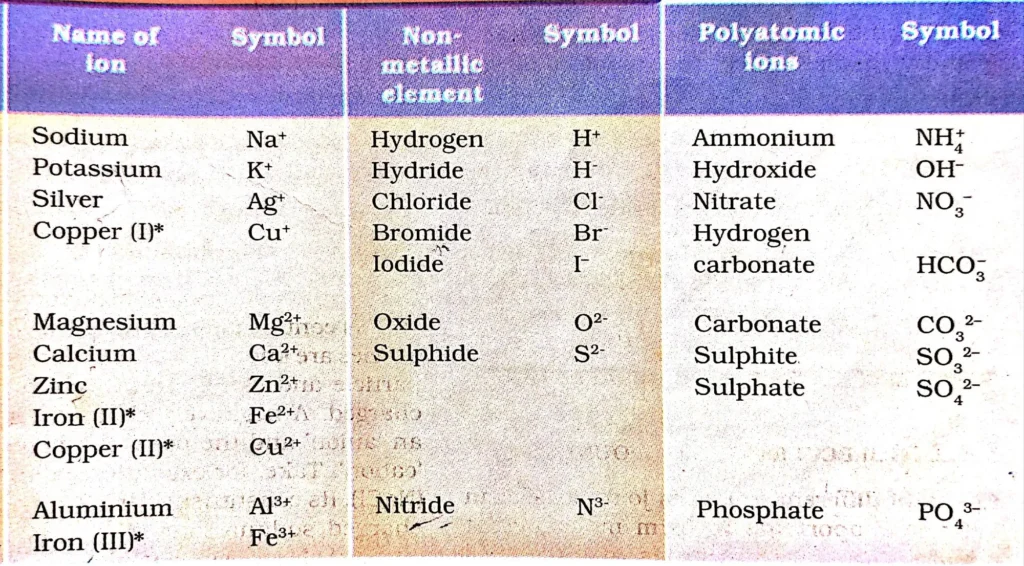
प्रमुख आयन
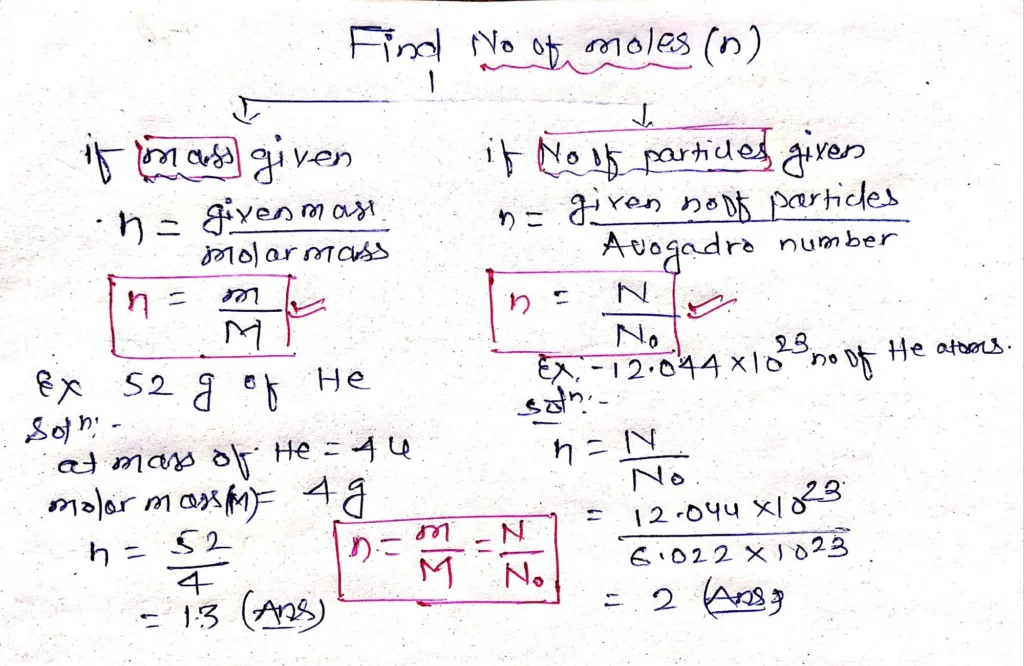
Mole | मोल
1 mole = 6.022 x 10²³particles (atoms, molecules, ions) = Relative mass in grams
known as Avogadro’s number/Avogadro’s Constant represented by N0, italian scientist amedeo avogadro.
used to measure quantities in chemistry.
It connects microscopic particle numbers to macroscopic mass (grams).
1 gross = 144
mass of one mole of a substance (measured in grams) is called its molar mass (gram atomic mass).
1 H2O atomic mass = 18u
1 mole H2O molar mass = 18g
6.022 x 10²³ molecules H2O molar mass = 18g
The term “mole” (mol) was introduced by German chemist Wilhelm Ostwald around 1894–1896, derived from the latin word moles meaning a heap or pile.
आणविक द्रव्यमान | Molecular Mass
the total sum of the atomic masses of all atoms in a molecule, typically expressed in atomic mass units (amu) or Daltons (Da).
H2O = 18u
HNO3 = 63u
It represents the mass of a single molecule, often used to characterize chemical compounds.
1 amu is defined as 1/12th of the mass of a carbon-12 atom.
Formula unit mass – the sum of the atomic masses of all atoms present in the simplest formula unit of an ionic compound, expressed in atomic mass units (u) or .
It is used instead of molecular mass for ionic compounds (e.g., NaCl, CaCl2) that exist as continuous crystalline lattices rather than distinct, single molecules.